Do Not Trade or Invest Without Reading This
The absolute worst mistake all new investors make
You think you’re ready for the stock market. You open your first brokerage account. The crowd goes wild. You are the next millionaire stock picker. Warren Buffett? He’s got nothing on you.
So you start searching for some stocks.
Mostly you look at stocks you’re familiar with. Because you use the products or see the brands everywhere.
You start with Netflix. That’s your best friend these days. But wait. One share costs more than $100? Like most new investors you only have a few hundred dollars to invest. You’re not trying to spend it all on one or two shares.
It’s all good. Let’s look at Apple… Same thing. Okay what about Amazon? Okay f that. That’s worth $900 a share.
You’re already doing it all wrong.
Price should not matter to you. You need to only care about the current valuation of the company. Here’s a quick example to show you why price is so disastrous to follow. Let’s pretend a company called Big Ballers (shout out Lonzo Ball) trades for $1 per share and there are 90 billion shares outstanding. On the other hand there’s Nike, which is trading for $55 per share but there are only 1.65 billion shares outstanding.
You only have a few hundred dollars. So you might think it’s better to buy Big Ballers at $1. Heck you can own 100 shares for $100. In the case of Nike, you can barely own 2 shares for $100. But here’s the thing. The quickest way to calculate the value of a company is to multiply the amount of shares outstanding by the price of one share. So in this case, Big Ballers has 90 billion shares outstanding. You just bought a company that’s worth $90 billion and they have practically no revenue. Or
The hardest thing about the stock market is losing money. If you’re reading this, I’ve been there just like you. It is frustrating, regretful, and worst of all, taxing on your mind and well-being. I wrote this post for myself, because I remember the days when I lost money in the market, and I think it will help me or others once again down the road. Enjoy! Five ways to stop losing money in the market:
- The majority of people who I have met in my time who lost money in the stock market did one thing really wrong: they knowingly took on too much risk. They, for example, put all their money into one asset or aggressively traded with margin. If this is you, you need to realize that you signed up for this. This was your decision. It may be hard to hear, but that’s the truth. So what next? Take a step back and start learning about diversification and risk management. The best traders ever, for example, rarely risk more than 1% of their money on single investment or trade. What I mean is, they put 1% of their capital toward a position and if that position goes to $0, so be it. At least it was only 1%.
- Of all the people I have met in my time doing this, they all say that once you’ve come to grips with your lost money and reckless strategy, the next thing you need to do is step away. You need to clear your mind. Get away from your phone or computer and go exercise or get outside. It is a reminder that you always have your health. It is a way to refresh and rest your mind for the next decision you have to make. As long as you have your health, as long as you can move, you can
- Avoid tilt at all costs. Tilt is a symptom of gamblers that has been studied and observed time and time again. It means you a desperate to get your money back and to get it back you are willing to do anything even if that means taking out more debt and more risk. This is a bad way to think because with everything in life, there is no easy money. You will just lose more and be desperate for more. You need to think about a long-term plan for saving, creating value, and earning money through hard work. Period.
- Sometimes talking to a professional can help. They have been there. If you know someone in the industry who you trust and can vent to, reach out to them. They will walk you through their own experiences in these hard times and it may even feel good just to talk to someone who knows. The market is a hard game and it’s not designed to make you rich. It is designed to take your money. Talking to some will at least open your eyes back up to the community around you.
- Going forward, you need to have a system based approach to markets that includes risk management and diversification. Discretionary trading or investing i.e. “just buying randomly because you like it” or “just trading on a random tip” rarely works for anyone ever long periods of time. The best methods are thoughtful, slow, and time-tested. Generally they are automated and each buy or sell order is determined by a strict set of criteria that triggers. This kind of approach will help going forward.
I hope this quick guide helped and, by the way, I am no guru or expert. I have won and lost just like everyone else in markets. But, I am pleased to share these thoughts so others can read it and more importantly, so that I can hold myself accountable and never run into this problem again.
Why Time Frames Are The Most Important Stock Market Skill
The worst mistake I ever made in the stock market all started with the TV
It pays to turn it off.
I’ve been there before and it’s brutal. Omg I just heard a wild idea on TV. Buy, buy, buy. You need to get in this before everyone else does. Get to your computer right now man!
I once did that with Japanese banks. I thought I was going to be a master trader of Japan. The young guru. Being young and overconfident is an amazing thing. To this day I still literally know nothing about Japanese banks. But someone on one of those shows pitched the idea. It sounded crazy, but crazy enough to where maybe it was a slice of brilliance!
It did not go well.
It’s probably the worst single investment I’ve ever made. And this is coming from a guy who once tried to pick a reversal in the National Bank of Greece:

Some of you have also probably been in a similar position. Especially in your very early days of investing. You hear an idea and it sounds like a pure money maker. Then you head to a computer, thinking you need to do this before everyone else does, like you can’t waste another second or you might miss it. A few days or weeks later, that idea you thought was pure gold has fallen apart like the Cleveland Browns.
Just press the like button already if that’s been you. No shame. It’s why a piece like this has to be published. It’s kind of surprising how few people comment or write about this for the sake of the average retail investor.
But why?
The thing with financial TV is they need to fill airspace at all times. No time can be boring and no time can be wasted. Time is money on TV. The content and ideas are not so much about quality research or trying to be good stewards for everyday investors, but instead about trying to pitch “can’t miss” stories and then selling ads based on the viewership those stories receive.
People always talk about fiduciary duty in financial markets. Meaning money managers, banks, and professional investors must act in good faith toward their clients. But the financial media is basically never held to those same standards. And that brings me to the following tweet that some investors might call a work of art. Like it’s The Last Supper for traders:

Are those the headlines you want to follow?
The thing about financial decisions, and especially trying to call tops or bottoms, is that it’s really hard to do. There’s a mind-boggling amount of randomness involved. And there are a lot of smart people out there taking the other side of your idea every single day.
While financial TV is trying to fill airtime, the reality is that good ideas and investments take time. I think the excerpt you’re about to read below does a great job explaining just how stressful, hard, and difficult it can be. The perfect investment decision is not a 30-second sound bite on your TV:

I’m still a mediocre investor. But I’m also crazy dedicated to the game. I keep reading, researching, and following markets. The growth has been slow, but I’m in it for the long-haul. A few big lessons have emerged over the years. One of them is this post, which seems simple in theory, but still many new investors fall victim to at some point.
If you’re new to markets and reading this, hopefully I just saved you a few dollars. If you’re a wise investor with hair flowing like Gandalf, hopefully we just shared a few laughs — don’t take financial advice from the TV.
There’s a big problem with checking stock prices everyday. It narrows your focus and distorts price movements. What happens is price changes begin to be viewed by the minute or day rather than the week or month.
Here’s an example.
If you watch the market by the minute — well this recently happened and you might remember it. I know a lot of people who watched markets like this and the swift move crushed their portfolio:

That looks pretty harsh. The market rarely ever drops like that. 5% gone.
Whoosh!
However, as devastating as that looks, you have to remember the chart you just saw is minute-by-minute time frame chart. That means it is showing each minute of trading. That’s way too narrow. Time is bigger than that. Watch what happens when the chart zooms out — the noise gets smoothed and a much bigger picture is presented:

Always remember to zoom out. And always remember that time never stops, human progress strives to push forward, and the longer term picture is a much better way to grasp the reality of a situation. Thanks for reading and that’s why time frame is the most important skill to investing.
Why Timing a Stock Market Crash Is Hard
Crashes are fast, unpredictable, and the overarching trend is up.
I recently came across a chart that shows the S&P 500 since 1920. It highlights its biggest bull markets and its worst bear markets. The stock market is filled with notorious stories about rogue traders who shorted stocks at their peak and made massive profits on the way down. But while we applaud those stories and write about them with awe and mysticism, the amount of luck and those before them who failed rarely gets the attention it deserves.
The book and movie The Big Short is a great example of our obsession with top callers and those who make money on the impossible. Hollywood loves it, as does the media and others. The story sings to the ears of the average person about the lone trader succeeding or doing the impossible.
The rogue trader who bets against everyone. The lone wolf who gets it right while everyone else gets it wrong. The man who makes millions while telling everyone, “I told you so.” The one who everyone doubted, succeeds.
However, for everyone one of these stories, there are millions of others who never quite made it or were totally wrong and lost it all. Everyday there are people trying to call tops and time the next crash. And everyday a lot of them are failing. If you add up all the profits from the people in the Big Short and then add up all the losses of the people who tried to call a top before them, it’s possible it might be equal.
All the losses of those who tried to short the market in 2005 and 2006 = the profits of those who called the top in the Big Short.
Timing crashes is hard. Period. The chart at the bottom of this post highlights just how hard it is. You may immediately notice a few things when you see it. Here are several observations, facts, and things to know the next time you try to call a top:
- The length of a bull market is usually longer the length of a bear market — sometimes it’s a 10x difference in time.
- The length of a bull market can last anywhere from 2.5 years to 15+ years.
- The length of a bear market has never exceeded 3 years.
- When you add up the 9 bull markets since the 1920s, the stock market has been going up for more than 75 years.
- When you add up the 8 bear markets since the 1920s, the stock market has been going down for roughly 12 years.
I believe this chart shows just how hard it is to call tops and time the market. Bull markets can be long, powerful, and relentless while bear markets tend to be quick, random, and completly unpredictable:

How To Avoid Bad ETFs and ETNs
ETFs and ETNs are getting more popular, but you still need to be careful. Here’s how.
You probably own an Exchange Traded Fund (ETF) right now. You also probably know how easy it is to buy, sell or hold a sector, index, or basket of stocks disguised as an ETF. Click and it’s yours. You now own a cyber-security ETF that holds 15 stocks in the sector. But wait, let’s not get ahead of ourselves. It can’t be this easy, right? Each year, a lot of new investors get burned badly on ETFs.
The name of an ETF or ETN is not always representative of what the ETF does. For example, just because it has the name “oil” in it does not mean the instrument perfectly tracks oil. You need to dive deeper. Every ETF has a prospectus and that essentially explains what the purpose of an ETF is. If you don’t read the prospectus, well, good luck. You could be buying something really weird.
Let’s look at the ETF that trades under the ticker USO. That ETF is called the United States Oil Fund. If you’re an average investor just trying to buy some oil, you might do some research and stumble across this ETF thinking, “that’s perfect, I want to buy some US oil!”
But USO is actually a terrible long-term investment if you’re trying to buy and hold oil that’s drilled and refined in the United States. Like absolutely horrendous. Here’s a chart that shows you everything you need to know… and get ready. This chart shows the price of actual crude oil (black line) vs. the price of the United States Oil Fund ETF USO (red line).
What do you see? 🙈

That divergence looks bad. And yes, people are still holding USO thinking they’re buying crude oil for the long term. The good news, though is this, you can avoid this trap by doing one simple thing — READ the prospectus. Here’s what the creators of the USO ETF wrote in their prospectus:
“Investors should be aware that USO’s investment objective is not for its NAV or market price of shares to equal, in dollar terms, the spot price of light, sweet crude oil or any particular futures contract based on light, sweet crude oil, nor is USO’s investment objective for the percentage change in its NAV to reflect the percentage change of the price of any particular futures contract as measured over a time period greater than one day.”
So yeah. The fund, despite its name, is admitting that it does not track the spot price of oil. You aren’t buying crude oil with this fund — nope, not even lose.
That’s only one example. The list goes on.
I recently met someone who lost $17,000 trying to buy the UWTI ETN, which was a 3x Long Crude Oil ETN. They saw the name and immediately assumed “Oh wow I could triple my returns if oil climbs!” He went all in with $17,000. UWTI was recently delisted and removed from markets altogether. He basically lost everything. The problem is that this fund was fundamentally flawed and only supposed to be used as a day trading vehicle. Had you read the prospectus, you would have known this was not a long-term investment.

The graveyard of sketchy and scamming ETFs and ETNs is getting bigger by the day. What about VXX, which is the S&P 500 VIX ETN? No, it does not track the VIX perfectly and its prospectus essentially admits to the long-term dangers of buying it. There is a section devoted to these risks, don’t ignore it.
And the list goes on and on while the simple lesson stays the same: before you buy any ETF or ETN you need to read its prospectus. Its name is not a guarantee of its purpose. All the things you need to know are in that prospectus and you can find it on ETF’s website or by typing it into a search engine.
I’ve been thinking about my investment style and how it’s changed over the years.
My first few years were pretty rough. I dove right in. I put some money in a brokerage account and just started. I was buying and selling with really no real idea. It was pretty reckless. But everyone starts somewhere.
The other day I started my taxes. That had me looking back at some old trades. Some of them are just awful. But hilarious. I had to include two examples in this post (see them below). I hope by writing this all down I’ll avoid making these mistakes in the future:
1. The P/E ratio is the absolute worst metric ever. It needs to be burned off the front page of every finance website. It is a backward looking metric. The stock market is forward looking. WTF. Avoid this. If a company has a really low P/E ratio, it generally has one for a reason.
2. Stay away from any and all foreign exchange risk. If you buy stock in an ADR or a company based in a country outside the US, and that country’s currency takes a hit, your portfolio is going to feel it. Managing investments is hard enough, you should not have to also worry about currency fluctuations.
3. Picking bottoms and calling tops is Russian roulette. A stock that’s down 50% from its highs can still drop another 50% from there. A stock that’s up 100% over a year can still climb another 100% in the next year.
Here’s one trade where I tried to be the man and short NVIDIA after a massive run

And here’s another. Yes, I actually said this. I thought the tech trade was over

4. Know where you’re going to get out before you make the investment. This makes life much easier. Before you buy a stock, know why and when you’re going to cut it out of your life if it goes against you. Don’t get trapped. Don’t waste time.
5. You need to be a master at avoiding FOMO (fear of missing out). There’s nothing worse than watching a stock spike, and so you buy it. You don’t want to miss out. You just need to join in. F that. Don’t do it. Chasing a stock rarely ever works.
6. Never buy a stock because of buyout rumors or because you think it will get acquired. You want to own strong companies not rumors or theories.
7. Always know your shareholder yield. Does the company pay dividends or have a history of buying back stock? That’s money being returned to you. If there’s no shareholder yield (dividends or buybacks), you’re basically left with a bet on growth. Know the difference. It will change your timeframe and expectations for any single investment.
8. You can’t ignore the overall market. In bear markets, they say all correlations go to 1. It’s hard to find quality stocks in bear markets. Everyone makes money in bull markets so don’t let it get to your head.
9. Study the tax code. It will immediately change the way you invest or trade. Trading can be a lot of fun. But at tax time it sucks. It’s a lot of work and even more taxes. You can save up to 20% on capital gains taxes when you hold a stock for more than a year.
10. The Internet is your best friend in the world of financial markets. But you have to double check everything. There’s so much free research available. There are also so many smart people writing and sharing ideas each day. But you still need to double check it all. If you like a trading or investing idea from someone online, make sure you corroborate the data yourself.
If you enjoyed this post, or really did not like it, or just want to comment on it, press the comment circle 💭
If you just want to show some love and say you learned something today about investing, press the green little heart below 💚
A Few Things I Learned Watching a Hedge Fund Manager Lose $4 Billion on One Trade
Maybe you also followed this story. Or maybe not. But basically a really big hedge fund manager, one of those guys who people quote and probably talk about at Harvard Business School, placed a super big bet on this company called Valeant.
Valeant is a pharmaceutical company trying to cure problems related to skin and infectious diseases. They actually also own Bausch Lomb so that means they have a giant eye care business as well. This hedge fund manager made a bet that Valeant would keep growing their business, diversifying, and acquiring. He once even called them the next, “Berkshire Hathaway.”
His prediction turned out to be wrong. Really wrong. The company crashed. They were immorally raising prices and partaking in some dicey book keeping operations. Just Google “Philidor Valeant scandal” if you want to learn more.
The end result looked like this:

So what did I learn from this story? Are there any interesting takeaways? I think so. And by writing this down I hope I won’t make the same mistakes. Maybe you won’t either:
- Risk management is everything. No single investment or trade should ever be able to wipe you out. You want to play this game forever. In 2015, this hedge fund manager had $12 billion in assets under management. He poured $4 billion into Valeant. So he essentially risked a third of his client’s money on a single outcome.
- Don’t ever average down! This hedge fund manager did not cut his losses when the stock started to crash. Instead he averaged down. He bought more. Then he played the options market. Just cut your losses if it’s not working anymore. That simple rule probably applies to other things in life, too. Get out. Paul Tudor Jones said it best:

- Humility is everything. If you are going to make a trade like this, at least do it quietly. Don’t go on CNBC and tout it. Or promote it. When everyone knows about it on the way up, they’re also going to know about it on the way down. It might make things even worse. The media and people will turn on you for entertainment, clicks, and laughs.
- Social media is your friend. There are some seriously smart people on social media. A few investment writers who are on social media totally nailed it. They’ve been writing about Valeant and its problems for years. To this their research is free and open on their blogs.
- It happens to everyone and it will happen to you. No one makes great investments 100% of the time. Everyone gets hit here and there. Even Warren Buffett admits to this. He wrote about it in his latest letter to shareholders:
“I made one particularly egregious error, acquiring Dexter Shoe for $434 million in 1993. Dexter’s value promptly went to zero. The story gets worse: I used stock for the purchase, giving the sellers 25,203 shares of Berkshire that at year end 2016 were worth more than $6 billion.” — Warren Buffett
- Narratives are fun, but you also need to see the data yourself. What’s really amazing is how this hedge fund manager lost a ton of money. But is he finished? Well, not quite. Someone recently showed me something — the following chart shows the price of Warren Buffett’s Berkshire Hathaway vs. this hedge fund manager’s company called Pershing Square. Yes, he’s outperforming Buffett! As a spectator, it’s fun to get into big story lines and narratives. But always make sure you corroborate your opinion with real data!

How to find random stock market signals that probably mean nothing but if they work out you can brag about them later
So many people are making beaucoup dólares these days. Crypto trading millennials are stacking paper to the ceiling, Vanguard is straight up BTFD’ing everything around like the boss ass tycoon that it is, and I’m writing in a style that’s ridiculously incomprehensible. I guess this is what peak bull market feels like.
Enter, E*Trade
The other day I was shown a commercial from E*Trade. As of this writing, they’re one of the biggest brokerages in America. For you avocado La Croix kids in the Bay Area, they’re like a Coinbase but for stocks. Or a Lyft route for buses. Anyways, the commercial they dropped goes like this:

Let’s just look at one screenshot in particular:

Mah gawd
This all had me thinking about E*Trade and the commercials they’ve run throughout their time as a major brokerage. Like the one with the baby saying “I JUST BOUGHT STOCK!” in early 2008 right before the crash:

But that’s not even the best one. Because during the DotCom Bubble, also right before the crash, they dropped this little monkey on the world:

Or if you missed it:

While I am not in the business of calling tops or predicting market crashes, I do think there’s some wild af sentiment emanating from commercials like this. When a mainstream brokerage is telling you “the dumbest kid in high school just bought a boat” and presumably because he uses E*Trade to get so rich, you have to take notice… Bro, I heard if you use E*Trade you can buy a boat!
I also am aware of how subjective and random these findings are. But don’t knock it until you’ve tried it and trust me if this market goes sideways or down from here you better believe I am going to brag every single day. I have nothing left to say.

Small footnote that I hope everyone reads: if the market goes right back to all-time highs let’s pretend this post never happened
Watch Your Money Disappear in Seconds With This One Easy Trick!
Bitcoin is the fucking future brah.
Actually, hold up. Do you even Ethereum bro? That’s where the magic is happening these days. If you don’t have any money, don’t worry. Go to a place like Coinbase and ask them for a loan. Now we’re talking. Let’s buy some cryptocurrencies with money we don’t even technically have.
Booooooom!
What a time to be alive!
Oh shit I am locked out of my account.
Oh shit Ethereum is crashing.
Oh shit Coinbase wants their loan back because during the crash my account value dropped below the minimum amount they require for taking that loan from them in the first place:

Sometimes the market legends, the guys who have seen it all, say the most real quotes of all-time. The other day I stumbled across one of these quotes. I’ve had it open in my browser for a while. I have to write about it. Or at least put it somewhere for my people to read with me.
If you’re an investor or trader, you are well aware of how it feels to lose money in the markets. It happens to every market participant at some point. You might be the king of buying dips or building the Dexter’s Laboratory of trading algorithms, but you’ve definitely lost money at some point. Maybe your losses are actually what made you sir king dip buyer or the algo maniac you are today. One of the greatest market thinkers ever, Paul Tudor Jones, once dropped some knowledge about losing and what it really means. Prepare for wisdom level 100:
“I think I lost $10,000 when I was 22, and when I was 25 I lost about $50,000, which was all I had to my name. I think it’s no coincidence that our greatest champions, our greatest artists, our greatest leaders, our greatest everything all seem to have experienced some kind of gut-wrenching loss. I think their greatness, in part, was fashioned on the crucible of that defeat. To a certain extent, I think that holds true in my field as well, and I am leery of traders who have never lost it all. I think that intense feeling of desperation that accompanies such a horrifically deflating experience indelibly cauterizes great risk management reflexes into a trader’s very being.” — Paul Tudor Jones
If you feel the quote above, or want to learn about the book that inspired Paul Tudor Jones to write it, you can get a fresh copy right now. The book is called Reminiscences of a Stock Operator and Jones gives it to all of his employees.

Why You Shouldn’t Be like Warren Buffett and What to Do Instead
Think about all the people you meet who try to invest like Warren Buffett.
“I want to be the next Oracle of Omaha” they might say…
“I want to be the next great value investor like Buffett” they might also say…
At one point in my life, that was me. You also probably thought it at one point. But if you’re trying to master a profession, copying the great minds before you is not going to get you very far. You have no advantage. Not only is everyone already trying to copy them, but the greats themselves would tell you they did not outright copy anyone to get to where they are. Instead they used the great minds before them as inspiration to do something new.
I think of that Isaac Newton quote, the mf’in founder of the laws of motion, who was so awoke in 1675 he dropped this little line on the masses:
“If I have seen further, it is by standing on the shoulders of giants.”
Newton did what he did by building on the discoveries of others. You could say he remixed them, or thought he could do what they did better. So he went out of did just that. Great investors also need to think like this. Don’t copy Warren Buffett, remix him or build off what he’s already done.
I started writing this post because I came across a quote from Dr. Michael Burry. Burry is the guy in the movie The Big Short. The dude who plays the drums, walks around with no shoes, and keeps mad conviction on his bet against the housing market despite everyone telling him he’s wrong.

When asked about being a great investor, Burry said the following:
“If you are going to be a great investor, you have to fit the style to who you are. At one point I recognized that Warren Buffett, though he had every advantage in learning from Ben Graham, did not copy Ben Graham, but rather set out on his own path, and ran money his way, by his own rules. I also immediately internalized the idea that no school could teach someone how to be a great investor. If it were true, it’d be the most popular school in the world, with an impossibly high tuition. So it must not be true.” — Dr. Michael Burry
Everyday I think a little bit more about who I will build on, and what type of investor I will become. I learn from my friends who work in financial markets and try to read as much as I can from the greats. Then I fuse their ideas and try to build something of my own. I’m currently 6 years deep in the game, but I think my theories and frameworks are getting better each year.
Who do you follow? Who are you building on?
How Investors Can Avoid Noise, Short-Termism, and Overreacting
What charts are you looking at?
About a year ago, I started an experiment. I planned to only look at stock charts on a weekly or monthly time frame. I was finished with daily and intraday charts. I started my experiment and now more than a year later, I’m here to tell you about a few of my thoughts.
Think Bigger Than Daily Charts
The first thing I want to say is how the default time frame for most charting services, from your brokerage to Bloomberg and more, is daily. So, if you pull up a chart of a stock, commodity or cryptocurrency, you will immediately see a chart scaled to show each day of trading. This is a psychological problem not enough investors, new and experienced, look into. Because what it means is everyone, from your grandma to the random person sitting next to you on the commuter train, is looking at daily charts and not thinking twice about it.
This is a problem. It’s a problem because daily charts can still sensationalize stock price movements. Here’s an example — I’m going to show you two charts. The first, which is below, shows the S&P 500 on a daily timeframe right after Brexit happened:

This next chart shows the exact same move, but this time you will see it on a weekly time frame. Meaning each candle now represents one week of action rather than one day. You can immediately see the difference in the two charts:

Match Your Investment Perspective To Your Chart
Each day, we are shown daily charts and some times intraday charts down to the single second. I believe that this is a constant drum of dramatic visuals adding unnecessary pressure on investors. It forces them to think in the short-term or completely disconnect their long-term goals from what they’re seeing now. Great investors are masters at blocking out noise and filtering information. They are not easily fooled by drama or hype.

If you’re having trouble thinking through investments patiently, stop looking at short-term charts and avoid everyone who forces these charts on you. Smooth out your charts, zoom out, and change your time frame. This simple experiment has helped my portfolio since I started the experiment. Since the switch, I’ve traded less and held positions for longer. I’ve aligned my goals with my visuals and I can feel the impact on a deeper level.
The Now vs. The Now + Tomorrow
The daily flow of news and price action is enough to drive an investor mad. No other investor in history has had access to as much data and news than you do right now through your iPhone. Let that sink in. Or look no further than the legendary behavioral economist Richard Thaler. He studied and coined something similar calling it, “myopic loss aversion.” Behavioral Economics has a great definition of this term:
“Myopic loss aversion occurs when investors take a view of their investments that is strongly focused on the short term, leading them to react too negatively to recent losses, which may be at the expense of long-term benefits (Thaler et al., 1997).
This phenomenon is influenced by narrow framing, which is the result of investors considering specific investments (e.g. an individual stock or a trade) without taking into account the bigger picture (e.g. a portfolio as a whole or a sequence of trades over time) (Kahneman & Lovallo, 1993).”
If there’s one thing I learned from my experiment, it’s that investors need to be more aware of their time frame across of all of media and the default charts they look at it. It’s not only helpful, but it’s actually a unique tactic to avoid things like myopic loss aversion. You may not know it, but all those daily and intraday charts are having an impact on your decision-making. They are exaggerating the short-term on a sub-conscious level.
Don’t Forget to Zoom Out!
I find myself thinking about what our investing world would look like if everyone only looked at weekly charts. I believe we would have less day traders, less overreaction, and less retail investors feeling dissatisfied with financial markets. Everyone’s time frame would be expanded and every chart would be less dramatic no matter the TV show or media publication that shows it. I plan to keep this going and I would encourage every investor to try looking at weekly charts more often and daily charts less often.
How the Founder of Litecoin Learned About Long-Term Investing
A story of trading and investing in the wild west of cryptocurrencies
Note: this post was not written to demonstrate why Litecoin is good or bad investment. Nor is it commentary on crypto in general. Instead, it is a post about oppurtunity cost, trading, and long-term investing. Enjoy!
Litecoin is the 5th largest cryptocurrency on planet Earth. It was founded by Charlie Lee. I don’t know much about Lee, but I’ve been reading more about him in an effort to learn about his currency. I don’t necessarily believe in any one crypto, but I do think it’s interesting to follow and learn about. While yes, Lee is the founder of Litecoin, it does not mean he’s insanely rich. He’s actually missed out on some of the biggest gains in history. But therein lays a powerful lesson about investing.
As of this writing, the market cap of Litecoin is over $1 billion. Back in 2014, someone asked a simple question on the Litecoin Reddit thread. They wanted to know how much Litecoin its founder owned? Lee logged into his account and delivered the following answer (bold highlights are mine):
“I have some. More than most (I’m guessing) but a lot less than some of the wealthy Litecoin holders out there. I want to think that litecoins are very fairly distributed.
I had 2 CPUs mining from the start. I stopped mining when GPUs came on the scene. You can probably figure out how many coins I mined. But I bought a lot more on BTC-e. At one point, when the price was around $0.007, I considered plopping down $7000 to buy a million litecoins just to have a million. For some reason, I didn’t. Oh boy do I regret that. Why did I not believe in my own creation?!? 🙂 When the price hit 20 cents, I thought it was overpriced, so I sold about 3/4 of my coins trying to play the market and thinking I can get them back cheaper. Silly me.
I’ve since learned buy and hold is the best strategy. So, I’m holding on to the rest of my coins until I can spend them everywhere!” — Charlie Lee
Wow. I read that and knew I had to start writing. I have three things to say about this and mostly from an educational standpoint. Here are my 3 takeaways from that response:
1.One of the worst feelings an investor can feel is something called error of omission. It simply means you did not do something that you thought or were planning to do. What makes this feeling so powerful is that it’s seen in hindsight and magnified by what you as an investor missed out on. A stock went up and you never bought it. Or in this case, a cryptocurrency exploded higher and you missed out even though you had told yourself you would get involved. The worst — and we’ve all been there.
In my opinion, all errors of omission start and end from a lack of personal process or system. If you have a system in place, one that determines why you should buy or sell an asset, and that something meets your criteria, you have to act. Without a system, everything is whimsical and at random. I believe the best way to remove errors of omission from your investing life is to follow a system that is strictly binary. Buy because of this or sell because of that.
2.It is remarkable to see how many people think they can time the market. Then there is Lee, the founder of Litecoin, who sold 75% of his Litecoin portfolio at 20 cents. Why? Because he thought it would drop and he could buy them back cheaper. A single Litecoin, at its high, traded for about $61. That’s about 30,400% lost in potential gains trying to time the market.
3.Buy and hold has been tested for over 100 years. I’ve shared the results by posting a chart below that shows the Dow Jones. If you believe in something and think it’s a game-changer, you need to be ready to hold through peaks and valleys. Even the best investments ever have gone through massive crashes and drawdowns — it’s part of the game. There is also something else happening here as well, though. When you buy and hold for te long term, you have to accept the consequences of it not working out. If you believe and also understand any asset at any moment can go to $0, then you are that much better prepared for ups and downs.

Wall Street Finally Found A Way To Trade Bitcoin and This Is What It Looks Like
It’s a house party and every trader is invited
A good friend who I grew up with just showed me a wild video. This guy at a Bitcoin conference grabs a microphone and starts to deliver a speech to the people of crypto. His name is Carlos and he’s from New York City!

The Wall Street Journal recently put this on their front page:

Was that you talking to Grandma about Bitcoin over Thanksgiving? Come on man you’re supposed to keep that hush.
Carlos is making some good money. So is your grandma. Maybe your friend from home is, too. But you know who still hasn’t made good money on it yet? Wall Street. There are basically no Bitcoin or Blockchain ETFs and mutual funds. There has yet to be really big cryptocurrency or Blockchain IPO. Think about the street salivating at the possibilities. Damn.
Let’s rewind to last September. There’s a biotech company called Bioptix. At the time they were making biotech machinery or something like it. It’s actually kind of hard to figure out what they were doing. They traded under the ticker BIOP. In 2015, they lost about $8 million and in 2016 they lost another $4 million.
So you have this pretty basic biotech company that’s barely making it. Then all of sudden they have a Eureka moment. You can see them in the board room right now.
“F it,” they say. “We out this biotech game.”
So Bioptix changes their name and Bioptix is ready to risk it all. Their new name is: Riot Blockchain. Riot mother f*kin Blockchain. Let’s go. They also change their ticker to RIOT. What happens to this new company? Your answer on one chart:

The stock basically went from $4 to a high of $24. Its market cap was about $20 million before. Now it’s more than $100 million as of this writing.
This is not the only example.
Overstock.com has been talking about building their own cryptocurrency and using Blockchain technology for their eCommerce business. Their stock chart looks like this:

A company called Marathon Patent Group, which was basically a penny stock and trading for only $1 a share, bought a company called Global Bit Ventures. If you look at the website for either of these companies, you may find yourself confused. What exactly do these companies do? One is a patent troll and the other has a website with a lot of random Blockchain vocabulary. Marathon spiked to a high of $10/share after buying Global Bit Ventures:

The closest thing to a Bitcoin ETF right now is something called the GBTC. It trades on the OTC, which some might call a super dicey version of the Nasdaq or NYSE. The ETF claims to hold about $1 billion worth of cryptocurrencies on its balance sheet. While that’s great, it trades at a 67% premium to its net asset value. What I’m saying is that people are literally paying 67% more than they have to just so they can own this ETF. You could buy a single Bitcoin right now for about $10,000 or you could buy the equivalent through GBTC and pay $10,670.

I could go on for longer. The last I saw there’s a list of 21 Bitcoin and Blockchain stocks out there right now. I’m sure it will only get bigger and more maniacal. Yes, some of these companies are the real deal, but the better lesson is that the stock market always finds a way. Whether it’s a scam or actually something real, the opportunities will be there. Cryptocurrencies will make it to Wall Street — you just have to find it, and do your research.
Turning $100 Into $26,000 Is Nearly Impossible, But Here’s How You Could
I’m just going to say it straight up: it’s very unlikely anyone will ever do this. If you’ve ever made an investment that’s as good as this, I want to hear about it. Press the comment button below and share your story.
What I’m about to show you is a chart of Netflix since its 2002 IPO. I don’t know where Netflix will go in the future or what’s next for it, but on this fine February day in 2018, Netflix hit an all-time high. It almost hit $300 per share.
So let’s go back in time for one second and pretend you invested $100 in the monumental day that was Netflix’s IPO. How much would that $100 be worth today? The answer is about $26,000. Read that again. Turn $100 into $26 grand in just 16 years. All while doing virtually nothing if you just sat on your hands and never moved.

I’m sharing this fact with you today for more than entertainment or FOMO purposes. I also know it’s ridiculous. I get it — no one would have held that long. This is a great response from a good investment writer:

The reason why I’m writing this post is because I think it’s important everyone knows what’s possible in markets. Especially those who only have a few hundred Dollars to invest or commit for the very long term.
So there it is. Your Netflix and make bills moment. If you can find the right stock, and if you can do your research and stick with it, the gains are there for the taking. I hope in 5, 10, 15, or 20 years someone out there writes me something like, “Yo Stef, I bought few shares of a company I liked, and spent $50 on it back in 2018 after reading your post, it’s worth $2,000 today!”
How I Made The Worst Trade of My Life
It happens to everyone at some point.
I wrote this post a while ago and just came across it today. I had it stored as a draft. I think I should have published it way back when I first wrote it. But I held off. I don’t know why.
Here’s the thing about the worst trade or investment of your life: it did not happen because you bought at the wrong time or because you sold at the wrong time. There’s usually some other part to it. It’s usually about what you did after the trade or investment happened.
So why did I make my worst trade ever? Revenge.
Let me explain.
Pretend you made a bad trade. A really stupid trade. And when you look back at the trade you are straight up bewildered as to why you did it. Suddenly your account is down on the day. That was not smart of you. Come on, you know better.
“Okay” you think, “I’ll never do that again.” But now you’re getting angry and it’s building the more you think about it. You want revenge. You want redemption.
You lean forward, inching closer to your screen. You look at how markets are moving. Then, at that moment, the thought hits you, “I’m going to do one more trade and make it all back. I’ll do this once, get back what I lost and never do it again.”
It rarely ever works out like that.
Your mind is rattled and not thinking clearly. Never invest or trade with a rattled mind. This is when revenge trading starts, and when it starts, it spirals out of control. Suddenly, the following steps are you:
- Bad trade
- You try to make it back
- Another bad trade
- Now you try to make it all back
- An even worse trade
- One more
- Now it’s the worst trade of your life
There’s no telling how long that cycle goes on for some people, but just like that your day took a beating and so did your account.
https://atomic-temporary-146473990.wpcomstaging.com/media/d7b8a28e67f695a2a0df419e6321a73e
The thing about losing money while investing or trading is that it needs to be quick and forgotten about immediately. When you take a loss, you should never trade thinking you have to make it back. Forgot about it and move on. There are several thousand stocks in the market and even more if you count cryptocurrencies, and derivatives. The potential is endless and it’s not going anywhere. It’s also really hard to make back losses and it gets worse the more you lose.
This is a table I always look at now:

I am not the first to experience revenge trading and I also am not the last. But I am happy I could write and finally publish this post today. Maybe it will help a reader down the road. If you have any wild stories about your worst trades, feel free to send them in the comments below.
Find Your Investing Routine
Consistency pays from the Jobu voodoo doll to daily workouts.
Have you seen the move Major Leagues? It’s about a struggling Cleveland Indians team. A young Charlie Sheen puts on an incredible performance playing a wreckless bad boy pitcher named Ricky Vaughn. He throws pure heat and comes out to a blasting Wild Thing song. That’s his routine. And that’s what this post is about — finding your routine.

There’s another character in the movie who some of you might also remember. His name is Pedro Cerrano and he can’t hit curve balls. He finds a routine that for one reason or another solves his problems. He starts worshipping a voodoo doll named Jobu. For this is the sacred way of connecting your mind and body with the curve ball gods.

I wrote this post in the middle of baseball season and it has me thinking about the routines that happen throughout the sport. If you follow the MLB, you know. If you don’t, the examples from the movie Major Leagues is really just scratching the surface. Players have all sorts of routines, rituals, and and specifically how they prepare for games. I’m not sure any other sport has so many superstitious players practicing rituals.
I remember when the short stop Nomar Garciaparra would do a little dance, check his gloves, and his cleats before stepping into the batters box each time. That happened three times a night throughout an entire season. I also remember Ichiro Suzuki, who would point, shoulder shake, and stretch out his arm before each bat.

In investing, I think your routine can help your performance. What do you do to start each day? Or before each trade? Or even for your general strategy? Warren Buffett once said, “I just sit in my office and read all day.” That’s his routine. Reading and studying as much as possible.
Routines have been well documented across all sports and industries.Another favorite of mine was the NBA player Jeff Hornacek. His free throw ritual was interesting. He would touch the side of his cheek before every shot at the foul line.

Everywhere you look, you will see it. Especially if you pay close attention. Michael Jordan would stick his tongue out and Stephen Curry shoots a shot from the tunnel. Before every game, Lebron James walks to the score table and throws powder into the air.Powder in the air! Make it rain powder LBJ! You might think this would get exhausting in a 80+ game season, but that’s his thing.

The point of the ritual is to prepare you a task you want to do well at. Maybe there’s that one thing that will push your focus to a level higher than where it would be without it. I’ve heard meditation helps, and I’ve heard using a journal or a checklist helps. I should try both at some point.
When I was growing up, my dad loved routines. He would run several miles every morning before 6 AM. That one ritual started the entire day for him. As a kid, I would try to join on a few runs, but damn 6 AM was hard to do. Early morning runs are still hard for me and I doubt it will ever be a ritual of mine. Everyone approaches their routines differently.
We see professional athletes practice their routines all the time. Rarely do we hear or see everyday professionals practice their routines. If Lebron was an everyday guy working a normal job, I wonder if he would still care to through powder in the air — maybe grounded coffee. I think investors can benefit as well. As long as it helps you succeed at the thing you love, that’s all that matters.
Investing in New Frontiers
Facebook was founded in 2004. Bitcoin in 2009. Old frontiers are often still very new. Knowing what they’ll do next is nearly impossible.
“Abiding in the midst of ignorance, thinking themselves wise and learned, fools go aimlessly hither and thither, like blind led by the blind.” — Katha Upanishad
That’s the first time anyone ever said anything like, ‘blind leading the blind.’ It’s from 800 BCE. That’s a long time ago. Rome had not even been founded yet, that’s how long ago it is. Homer had not even published the Iliad.
I wonder, if Homer was alive today, what he would write about financial markets now:
A millennial sits in a coffee shop
He sings with tweets
“HODL my crypto to all the moons!”
His goal is to own a lambo.
That’s my attempt at writing a modern Homeric stanza. As an investor, or someone interested in markets, history is the only road map we have — even if that means studying Rome, Homer, and Upanishad. It’s also why I think its important to be careful of things that have a short history. And a short history is anything under 100 years old.
I think of Cryptocurrencies, which in the grand scheme of financial markets, are still very new. So is social media. So is VR and AR. Our news, conversations with friends, and the things we read may make them appear old, over time, after a year of talking about them, but in the grand scheme of things that is very little time.
Today, there are cryptocurrency experts everywhere. They are both bearish (think it’s going down) and bullish (think it’s going up). They’re raising money for their ICO or they’re writing about the revolution taking place. However, what’s fascinating to me, is how someone can become so sure of one thing when that thing has less than 10 years of history behind it.
The entire world is connected now through Twitter or Facebook. Maybe that’s why “following” an expert is so easy. So, should we blame social media? But, even that is still in its infant stages. We’re debating privacy, fake news, and data harvesting that all come with the new social media world. I always remind myself that Facebook was founded in 2004.
That’s less than 15 years of history.
Is that really enough time to be an expert on something? And something that connects a few billion people? We still don’t fully understand the ramifications of it.
When I was growing up in the Bay Area, I remember when they were getting ready to introduce FasTrak. Those were the little readers that sat on your car’s dashboard and made it easy for you to drive through tolls on the Golden Gate Bridge. A machine would scan it every time you crossed the bridge and that was your payment style. One of the main arguments against FasTrak at the time was centered around the Government. People would say things like, “now they will know where I am and when I cross a bridge!” and “the Government should not be able to track us crossing the bridge!”
Let that sink in.
In just a few years, people went from freaking out about their privacy crossing bridges to carrying phones with GPS, video, and apps like Facebook that suck in everything about them, their lives, and day-to-day activities. I wonder if Mark Zuckerberg sits back in his chart at times and just says, “holy sh*t what have I created, how did this happen so fast?”
I wonder what Satoshi would say about Bitcoin. Maybe he’s sold a few coins, is sitting somewhere on a beach with millions, thinking, “I can’t believe that just happened.” I think that’s more probable than some revolutionary V for Vendetta figure striving to change the world. These products happened so fast, still have so little history, that their creation and permanence in society is still in explainable, I believe, even by those who started them. Why Facebook and not Myspace? Why Bitcoin and not Hashcash (a 1990s cryptocurrency)?
Young and exciting industries, like crypto and social media, are total game changers for society. But as much as we want to understand them, they are still so know. They are just happening and there’s no formula or anecdote that can explain it. At least not yet.
I’m not saying Bitcoin or social media is a bubble, nor am I saying it’s the future of our world. What I’m saying is that these topics are still too young to be an expert on. There isn’t enough history for anyone to truly get it. I think someday, after many years have passed and the smoke has cleared, we may look back and realize that ultimately it was a case of, “the blind led by the blind.”
A Few Things I’ve Learned About Managing Money When The Stock Market is Dropping
What I am about to share is everything I’ve learned, so far, about market drawdowns.
I am by no means an expert, I am still young in this game. I’ve been in it for about nine years now. I’ve seen one massive bull market, maybe I won’t see another like it in my lifetime, and a few market drops along the way. If you’re reading, you’ve probably been in this game longer. But maybe that’s why my thoughts could be interesting to you. How does a 20-something-year-old think about stock market drops?
The most important thing I’ve learned is that a market drawdown or correction is the truest test of how good you are as an investor. There are few greater market hymns than: NEVER confuse brains with a bull market.
I believe you’re only as good as your portfolio holds up during a drop. Markets do not go up forever. And when it feels like they are, especially during bull markets, prices begin to deviate in an extreme way from their intrinsic value. While your account may be flashing fat dollar signs during this climb, it’s not a true representation of your skill. The assets you hold are bound to correct. And it could happen at any moment.
I sometimes think of that movie Wolf of Wall Street. Sitting high above New York City, jacked up on drugs and martinis, Matthew McConaughey says:
“Nobody knows if a stock is going to go up, down, sideways or in circles. You know what a fugazi is?”
“Fugayzi, it’s a fake.”
“Fugayzi, fugazi. It’s a whazy. It’s a woozie. It’s fairy dust. It doesn’t exist. It’s never landed. It is no matter. It’s not on the elemental chart. It’s not f’ing real.”

I love bull markets.
We all do.
Money is sloshing around, and prices are rising. Companies are printing cash, and buying back stock. It’s electric to be apart of something like that. But it has a tendency to get too far ahead of itself. Suddenly, everyone is looking at their account thinking, “whoa, I’ve made a lot of money.” When your account begins to diverge from what you know its true worth is, you may find yourself in awe. Is it real? The word fugazi comes to mind:

It’s at that moment when your portfolio is worth more than you ever thought it could be. But can you really harvest those gains right at the peak? The answer is no. Market timing is impossible, and even worse — trying to trade your portfolio in and out of falling market can be extremely costly. It’s a rabbit hole no true investor should go down.
If you’re confident in the assets you hold, and the plan you have in place, a market drop should not scare you into making impulse decisions. They come to strike euphoria out of the air, and bring prices back to reasonable levels. One of the hardest things to understand is that corrections happen, and you won’t always be able to slide in and out. The better solution is to accept their occurrence and be ready when they happen. My friend Ivaylo Ivanov has a great perspective on falling markets, and understands their natural appearance:
“The market is not going to be healthy all the time. 8% to 20% corrections happen at least once a year every year. Steep corrections create incredible opportunities, but you have to protect your capital in order to take advantage of the recovery.”
As I grow with markets, I’m learning about how important it is to be prepared for the bad days. That’s more important than being prepared for the major rallies. That’s risk management, and that’s how you avoid ruin. Here are three things I’ve learned from others about preparing for the bad days:
1Cody Freeman is an expert trend follower who I’ve only met online. I follow his posts as much as I can. He thinks market drops and corrections are a great time to reflect on your portfolio. It’s a time to look at what’s working, and what isn’t. Maybe you should reduce exposure to the things that are getting hit the hardest, as perhaps this is a foretelling sign:

2What you are about to read is the best investing hack I’ve ever come across. It’s a moonshot, but I love the idea. It has not yet worked for me, but hopefully it will soon. The premise is simple: pick some companies you’ve always wanted to own, and put in buy orders 10% or 20% or even lower from the current price. Just maybe, like a Doug Flutie hail mary, the market will flash crash, and you’ll be there to soak up the panic. I’ll let these two quotes from a Josh Brown blog post explain:
“I pick five or six of the best stocks in America that I’ve missed out on — the ones that have always bothered me. Everyone has their names. A contemporary list might include Netflix, Amazon, Facebook, Disney, Celgene, Starbucks, Chipotle, Goldman Sachs, etc…
Next step — I create GTC Buy Limit orders for a handful of these stocks at the exact absurd prices I’ve come up with.
When you have these absurd limit orders on excellent stocks in place, something wonderful happens to your frame of mind. It is completely rearranged and you find yourself beginning to root for even more downside. It makes no sense, of course, because the rest of your portfolio is declining in value — but your fixation on seeing one or two of these absurd prices hit completely overpowers any concerns you have. You begin rooting for the correction to continue!”
3This final lesson sounds easy in theory, but difficult in practice. When everyone else is making money, it feels like you need to also get involved. Go all in! Invest all your cash! But during a correction, there’s nothing more important than cash. You can’t have fun if you don’t have any greenbacks on hand. If you don’t have cash, you can’t buy dips or even have fun swinging for the fences with limit orders at prices way below their current levels. Cash is everything during drawdowns.
The goal is to get better. How do you navigate through a falling market? I think writing down your thoughts and plans helps etch that into stone. It holds you accountable. Maybe a few years from now, when you’re reading my posts, I’ll be telling you about the perfect dips I bought in a downturn, or how I cut my worst positions before they could get even uglier. Someday. Keep following along.
The Hardest Part About Investing is Ignoring the Headlines
Let me tell you about one thing I still do wrong all the time
Let me take you back to 2009. The Financial Crisis was raging. I was in school at the time. I lost money trying to buy the dip in bank stocks. $300 to a student is a month of burritos, and there is no greater thing I can think of at that age. I bought the worst bank of them all… Washington Mutual. What was I thinking?
Maybe I could turn a month of burritos into two months.
I had read that a potential buyout was coming. That JP Morgan would save them. I read wrong. Little did I know the CEO rejected that buyout in private talks, and the price action was the only thing I needed to be looking at. The charts usually say everything. I wish I understood that concept before I put $300 on a WaMu comeback:

Over the years I have wrote several times about my biggest mistakes in investing, and how I do not want to repeat them. But there’s one that keeps getting me. No matter how many times I write about it, I still, at times, find myself under its influence.
That one thing is headlines.
That is the siren song. I am tied to the ship’s mast with several yards of rope, and still she somehow entices me. She sings of rumors, product releases, war and politics. Her song never stops. She’s been singing since the markets first opened in downtown New York City next to the Buttonwood tree.

Jim Chanos, the legendary short-seller, the one who called the collapse of Enron, once wrote about the impact of financial headlines on his life as a short-seller. Chanos said the following about the song I speak of:
“If you think of wall street, it’s a giant positive reinforcement machine. Basically, I come in every morning, flip on my Blackberry and check Bloomberg at five in the morning. And of the hundred short ideas that we have in our global fund, I can pretty much predict there’s going to be about twenty to twenty five percent everyday where there is some sort of commentary, research report, analyst buy recommendation, estimates raised, or CEO’s on Bloomberg or CNBC. And generally, it’s noise. Generally there’s not much information or content in that, but it’s nonetheless positive noise. It is why you should be investing in company “A” “B” or “C”.
Most people don’t notice this because they’re in the business going long securities. I like to say this is the muzak that plays in the background of the investment world. But if you’re a short seller, this is negative reinforcement. You’re being told that one-quarter of your portfolio every morning is wrong. For most people, that becomes a difficult environment in which they continue to think clearly about their investments. There’s a constant drum beat of just negative reinforcement saying you’re incorrect, you’re incorrect.”
I think you can flip what Chanos said upside down, and apply it to long-term investors and traders, too. The constant cycle of business news, and investing tips is your greatest enemy. It’s people trying to make easy money. It’s people trying to fill up airtime for sponsors and advertisers.
I know no great investor who has ever attributed their success to news or headlines. If you know anyone who thinks like this, I will be straight up in awe. I want you to reply to this post with the names. My only guess is that quants are out there rekking the rookies. Here’s an example: a stock pops because of some “breaking news.” What do the quants do? Ride it higher to exhaustion, make the rookie money chase, then fade the entire move.
That would not surprise me one bit.
The money in headlines is shaking people out. It’s tricking them into dreams of grandeur, then shattering them. Headlines are glass castles. I believe many cryptocurrency investors were destroyed by entering these glass castles.
The other day I was reading Warren Buffett’s 2017 investor letter. Even he, the great Oracle of Omaha, dropped some fire about the noise that surrounds investing each day. But of course, like the legend he is, he’s found ways to scoff at such hysteria. He writes:
“Charlie and I view the marketable common stocks that Berkshire owns as interests in businesses, not as ticker symbols to be bought or sold based on their “chart” patterns, the “target” prices of analysts or the opinions of media pundits. Instead, we simply believe that if the businesses of the investees are successful (as we believe most will be) our investments will be successful as well. Sometimes the payoffs to us will be modest; occasionally the cash register will ring loudly.”
Only three things matter to you in the investing world. News is not one of them. You have three things to focus on. That’s it. When one of these three things change, you should change your mind:
- Quarterly earnings reports where you can see if the company is hitting its goals both within in management and financially
- Price action where you can see if price is going up or down over a long timeframe
- What you see when that company or product is face-to-face with you in the real world — do you use the product? Is it good? Do other people use it?
So I write this post one more time to myself. Hopefully I will never write it again. But I doubt it. The siren will sing, and I will dance to her song. She has a great voice, even I will admit. If you can ignore it, however, it’s imperative that you stick to your plan. Never let news shake you out of a position or even worse, entice you into taking a position.
How Charts Confuse Investors
What I am going to do is show you two charts. It will be an exercise in perception. And it will be quick.
The first chart looks like this:

What do you think of that chart? Would you buy at the levels it’s at right now?
I know a lot of people who see charts like this and think, “it looks daunting way up there.” Or, “why buy now up there when you could have bought way lower.” There’ no right or wrong answer here, however.
I often hear that price is truth. And that price does not lie. But by itself, without any other information to work with, it’s actually meaningless. It’s a vacuum of randomness. The chart above was just a 4-hour chart of Apple during late 2010. When you zoom-out from that period, the picture now looks like this:

The lesson here isn’t about when to sell or when to buy. Or even how long you should hold. You can swap in or out any chart you want in the above examples. You could even find one where the chart eventually goes to zero, and the lesson is still the same. You can’t let a single piece of information persuade your decision-making. More importantly, you can’t lose sight of your timeframe, and how that piece of information applies to it. Moves that happen throughout a day feel significant in that moment, but are nearly impossible to spot when plotted over several years.
When people search to see how their stocks are doing, price charts are one of the first things they see. I was recently talking to a friend about Amazon, and it had me thinking about how people look at its chart, and process their thoughts:
First, a 5-day chart

Then a 1-year chart

Lastly, Amazon since its IPO
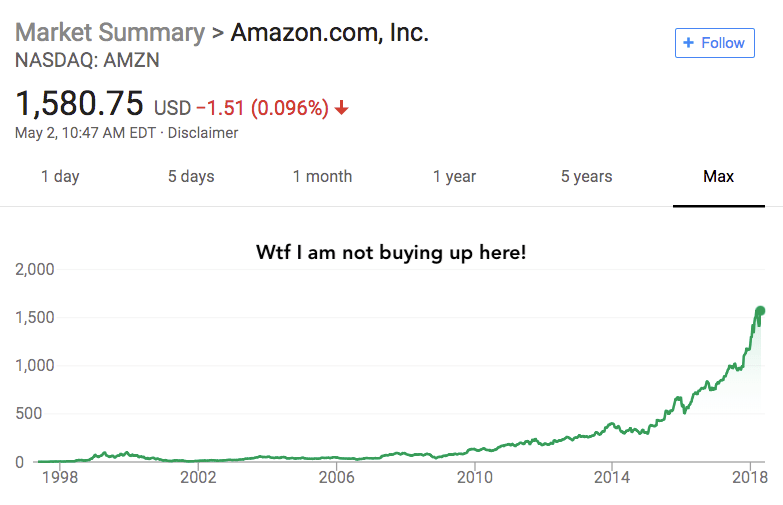
I’m not sure what the name is for the kind of bias or heuristic we experience looking at stock charts in these steps. From my research, it seems to be somewhere in-between an anchoring bias (relying too heavily on one piece of information) or an availability heuristic (recalling emotional memories or charged memories over everything else and forgetting about the normal instances).
I find that a lot of people, including myself at times, see big upward sloping charts, and immediately think about the few instances where crashes followed such climbs. The most powerful memories are those of panic, and those memories are the first things we recall. For some reason, it’s who we are. Perhaps it helped our survival several hundred years ago when we were wandering the Earth as nomads. It would make sense that your chances of survival are better if you remember the worst situations first so you don’t repeat them ever again.
But what if, in 30 years, Amazon takes over the entire world, and this happens:

In markets, this is all part of the game. Some people still won’t invest because every upward sloping chart they see is confused with the crashes they remember like the Financial Crisis, and Bitcoin dropping from $20,000. Or some people still won’t sell their worst investment because a few weeks ago it actually had one big up day! I always think about the few times I watched one day of price action, and nearly sold everything. Price is just one piece of information. It can’t be looked at alone. It needs context. And it needs a timeframe.
The First Step To Becoming a Do-It-Yourself Investor, and What I’ve Learned
Try writing your investing strategy down using ONLY a few sentences. Can you do it?
I believe in the rise of the do-it-yourself investor. I think it’s in its early stages, and is setting up for something massive. The barriers are falling down all around us. There’s nothing preventing anyone with any amount of money to getting access to capital markets, and learning about them. It’s never in history been this easy.

But every DIY investor is going to experience some hardships, and some lessons along the way. Stocks, crypto, what have you. There are a lot of smart people sitting at the investing poker table. They have more powerful machines, they have bigger teams, they have more money, and most of them have more experience.
I’ve been in markets for several years, and only now do I feel like I understand my strategy, and what I’m striving to do. I can write my plan out in a few sentences. I could explain it to a 5th grader. That’s the true test. That’s step one. I recently wrote these four sentences down:
I believe your best investing starts when you decide to only buy companies with management you believe in, a product you’ve enjoyed, and financial income to support their future vision. No matter the outcome, if you can check the boxes on those three things, you will rest like Sloth Kong napping in the trees of Costa Rica. Most people don’t learn that for years, however. They lose money buying the wrong stocks based on hype, tips, headlines, and lack of do-it-yourself research.
There’s no easy path to earning a seat at the investing poker table. The saying really is true. How does it go again? If you look around and you’re not sure who the patsy is, you’re probably the patsy. You may not realize it now. But at some point, when the trend changes dramatically, and it will change, there’s a lesson to be learned about just how little you knew.
If you’re just getting started, what you write today will not be the same as what you write five years from now. It is a start, though. That’s important. You can take this strategy to the poker table. You can make controlled bets based on it, and you can learn about what’s working, what isn’t, and where you want to be sitting in the future. You’re putting yourself in a position to evolve, and evolution is literally life. I’m so woke on this I’ll drop a mf’in Bruce Lee quote to get the point across:
“If you always put limit on everything you do, physical or anything else. It will spread into your work and into your life. There are no limits. There are only plateaus, and you must not stay there, you must go beyond them.” — Bruce Lee
I uses these posts to evolve my own thought process. I’m writing it down, and holding myself to a standard that’s open to the entire Internet. I would encourage everyone to do the same. Or at least try it once.
I think if you want to be great at anything, and especially at managing your own portfolio, you need to put yourself through a process of growth. It all starts with defining your strategy in the simplest possible way so even a 5th grader could understand it.
The Hardest Lesson About The Stock Market, and Why Most People Become Investors
There is no such thing as easy money.
Hedge fund legends are making billions, Warren Buffett is the richest man alive, and to get lambos, lobster, and dollar bills raining from the skies you need to be a master at markets. Trading stocks, crypto, anything from soybeans to crude oil, people everywhere seem to think that this is the way to quick riches. And many will try it.
But trading is really hard.
There are scammers out there who want your money.
There are machines and massive companies who does for a living.
Trying to outperform the market is really f’ing hard.
But when you’re young and ignorant you don’t think like that. You think you can do and beat anyone at any task you try.
I spend a lot of time on the Internet talking with traders and investors from all backgrounds. I’m most fascinated by the rookies. The new kids. The ones who are trying to figure it out because they saw an Instagram ad from a penny stock pro saying, “if you trade like this, you can be rich like me!” or a crypto guru convincing people that, “this altcoin will change the world, get in now!”
I am lucky to say that I’ve never been scammed, and luckily when I was young I never fell for traps like this. Anyone promising insane monthly returns or a stock that was guaranteed to pop was an immediate red flag. I always feel bad for the people that do fall into these traps. Hope and a chance at suitcases of greenbacks is a powerful force.
Now that’s something I actually fell for — a chance at a suitcase of greenbacks.
Yes, I managed to avoid the scammers. But no, I did not manage to avoid my own ego. I know a lot of you reading have been there. There was a moment early on in your career, when you were just getting started, and you thought the game looked easy.
At the time of this post, I am fascinated by the plight of the company that owns part of MoviePass called Helios and Matheson (HMNY), and I keep thinking back to stocks like SunEdison (SUNE). I keep thinking about all people who think there’s a chance at making insane money in these stocks.
I remember hanging out with a good friend when I was living in Washington DC. He’s still one of the smartest people I know working as a consultant for one of the big three names. A massive six figure salary, a hard work ethic, and an MBA from one of the nation’s best schools. But one thing blew me away at the time. He was long SunEdison several months before it eventually went bankrupt. How in the world did he find this stock? Why was he buying it? What did he know? The answer is found in a thought process that I now realize everyone goes through once. Even the smartest people I know:
- This can’t be that hard.
- Everyone is talking about it, and I can’t miss out.
Here’s a chart of SunEdison in case you have no idea what eventually happened:

One bad play is all it takes.
One bad play is when you learn that market speculation isn’t for you.
I believe a lot of people are feeling this with Bitcoin today. I think many are also feeling it with the owner of MoviePass HMNY.
The feeling gets even worse at the realization of opportunity cost. If you had just bought a mutual fund or an index fund, not only would you still have your money today, you also might have more of it, and you also could have just sat around, potentially never checking the fund once.

Opportunity cost is economics 101. When people realize it, their ego goes from that Lion King scene on cliff in subsaharan Africa to McLovin in Superbad. In one scene you are preparing to be the new king of markets and in the other you’re in that awkward high school phase, really with no idea what you’re doing, but at least you tried.
Lion King to McLovin. Just like that.

Everyone who gets started in markets will most likely ignore this post for now. They’re too good to understand something like this. There’s no controlling the ego beforehand. It must be tested, tried, and broken in actual practice. A post like this will only make sense once you’ve gone through it.
I’ve definitely been there. Multiple times actually. And I’ve learned a great lesson. Something that actually expands beyond markets, and into my everyday life. Your harshest lessons will teach you that you’re not as good as you thought you were. In the same way most rookie traders eventually become passive investors, you realize you must find a more practical and cautious approach. You’ve underestimated the long-term plan of growth, and overestimated the boundaries of fast money. Or as Bill Gates once said:
“People overestimate what they can do in one year and underestimate what they can do in ten years.”
It Can Always Get Better, It Can Always Get Worse
Growing up, I played a lot of little league. I was a pitcher on my little league teams. On the mound I would get distraught when I couldn’t throw strikes and pleased with myself when no one could go near my fastball. To calm me, a phrase would be said, “Never get too happy, never get too sad.”
The point of the saying was that sometimes, the kids would hit everything, and other times they couldn’t even with a Ken Griffey Jr. bat. Stay balanced and don’t let the variability of the game impact you. It’s out of your control.
Today, I sometimes remix that quote. Lately, I’ve been saying, “It Can Always Get Better, and It Can Always Get Worse.” I like to apply this to the markets while I’m trading or following my long-term portfolio.
Momentum begets momentum, and it works on both sides — the good and the bad. You can find moments of it all around you, and in everything you’re working on. I think about athletes who catch fire. I think about artists who keep making big hits. I think about investors who keep picking the best stocks.
I’ve been watching Netflix’s stock price for years. I don’t know why I never bought it myself. Maybe it’s because I’m not a hardcore user. At least I’ve learned a great lesson following it for so long. What the stock has done is simply incredible, and I think of all the people I’ve met along the way, at one point even myself, who thought, “it can’t go any higher” or “it’s a bubble.”

The critics who doubted Netflix all the way up underestimated the boundaries of trend, and how long it can last. Momentum builds on itself. At times, it is exponential. At times it is random, and at other times it’s for good reason like underlying business growth. Regardless, it’s there and it’s grasping everyone around it.
I recently saw a tweet from one of the best market thinkers I know. Most you know him. His name is Michael Santoli. He does not necessarily think Netflix will go higher or lower. That’s not his job. His job is to inform people about what’s going on about the stocks everyone cares about. In one example, he compared Netflix today vs. AOL during the DotCom bubble. The point is, it can get more extreme:

If a student, or someone new to markets, approached me and asked about momentum, I would tell them about what I’ve learned from studying how Netflix trades. But I also wouldn’t want them to think this only happens on the way up. The same way a stock like Netflix can climb, and climb, and climb is the same way a stock can fall, and fall, and fall.
The other day I was looking at a chart of General Electric. I know many people who have owned this stock for generations, being passed down from family members, and employees who have been there for years. I keep thinking about GE’s brand, its history, its massive aviation business, and then its stock price. For more than a year, people have been saying there’s no way GE can keep dropping.
Did you know that GE’s stock from January 2017 to October 2017 was down 27%?
Did you know GE’s stock from January 2017 to December 2017 was down 44%?
Did you know GE’s stock from January 2017 up until the time of this post was down 60%?
In the same way it can always get better, it can also always get worse. That’s part of the problem on why trying to time tops and bottoms in a market. You never really know how good or bad it can get. I recently shared a chart about GE trying to find a bottom:

Trying to pick tops in stocks that keep rising, and catch bottoms in stocks that keep falling is a hymn market legends have sung about since the Buttonwood Tree. You’re choosing to fight against a force no one should be fighting. You’re better off knowing it could be there, accepting it, and working strategically around it.
When I started this post, my goal was to make the world of investing something bigger than it is. To show that at certain points its lessons and movements are parallel to the lives we live or are trying to create. Momentum is one of the most important concepts to understand in markets. But I now also think it’s just as important to utilize in your life. Or at least be aware of the ways it impacts you. Because it can get worse and it can get better. If you remember that, and if you recall it in the best and worst situations, you won’t be caught off guard if it accelerates against you. You will be waiting for it.